

How long should an OSHA-compliant hearing test take? Under the traditional model, a mobile van in the parking lot or an appointment at an occupational clinic, the honest answer is 15 to 30 minutes per employee once you count wait time, paperwork, and the walk to and from the testing station. With Soundtrace, the answer is about 6 minutes for the complete 29 CFR 1910.95 workflow. That number is not a marketing claim. It was documented independently by Purdue University in The Hearing Journal.
The Purdue Result: 30 Minutes Down to 6
In "Hearing Conservation Program Model in a University Setting: Building Upon Historic Success," Shannon M. Van Hyfte, AuD, CCC-A describes how Purdue University modernized its long-running hearing conservation program. Under the legacy model, testing consumed roughly 30 minutes per employee. After redesigning the program around Soundtrace's automated audiometers and software, average test time fell to 6 minutes.
Speed was not the only outcome. Employee no-show rates, which ran between 16% and 24% under the old appointment model, dropped to 2.7%, with 251 of 258 eligible employees tested during a single consolidated testing week. When testing is fast and comes to the workforce instead of the other way around, the participation problem largely solves itself. Missed tests are the root of the most common 1910.95 citations, a risk we break down in our guide to OSHA annual testing frequency requirements.
Where the 24 Minutes Went
Nothing about the audiometric protocol was shortened. The test still covers all standard frequencies on a calibrated audiometer, as required by OSHA and described in our audiometric testing equipment guide. What disappeared was everything around the tones:
- Automated threshold detection. The audiometer runs the full frequency sequence itself. No operator stepping through tones, no transcription.
- No booth, no travel. Continuous ambient noise monitoring replaces the sound booth, so testing happens in a quiet room at your facility. The commute is a walk from the floor. See how this works in our guide to boothless audiometry and OSHA compliance.
- Digital intake and e-sign. Health questionnaire, baseline comparison, and employee acknowledgment happen at the station. The 6 minutes covers the complete workflow, not just tone presentation.
- No data re-entry. Results sync to the employee's profile instantly, shifts are flagged automatically, and every audiogram routes to a licensed audiologist for review within 24 hours.
Multi-Testing: Where Speed Becomes Throughput
A fast test matters most when it multiplies. With Soundtrace multi-testing, up to 4 audiometers pair to a single PC or tablet, and one facilitator supervises all 4 live tests from one dashboard. Each station is independently calibrated, auto-pauses if room noise spikes, and submits results straight to the employee's profile, which kicks off the audiologist review automatically.
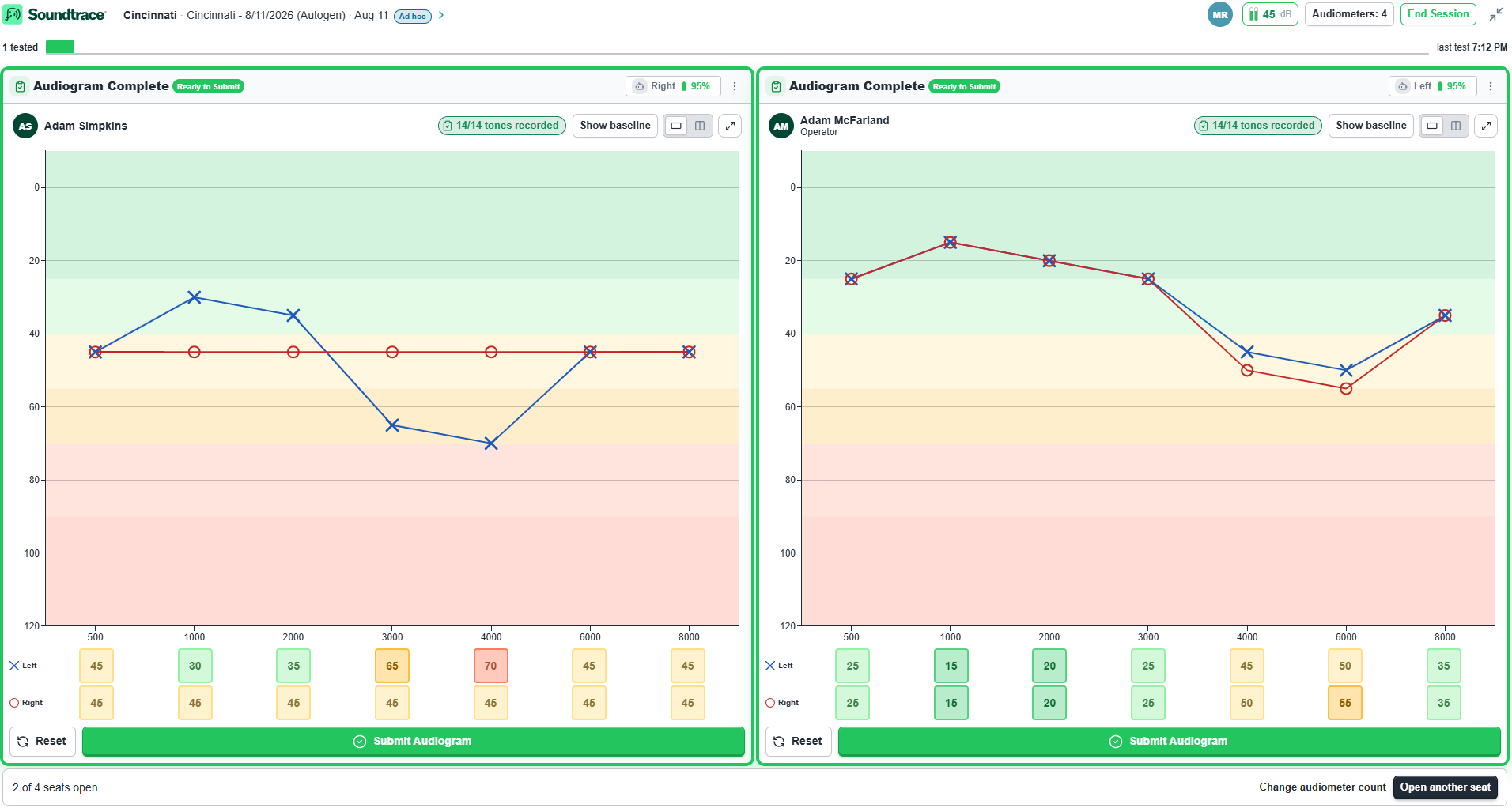
Throughput Analysis: 2 Facilitators, 8 Audiometers
Here is the math for a mid-size operation running two facilitators, each supervising four audiometers, with tests averaging 6 minutes. A group of 4 finishes in about 6 minutes; allowing for seat swaps, instructions, and the occasional retest, a realistic full cycle is about 10 minutes per group.
| Measure | Per Facilitator (4 audiometers) | 2 Facilitators (8 audiometers) |
|---|---|---|
| Simultaneous tests | 4 | 8 |
| Cycle time per group of 4 | ~10 minutes | ~10 minutes (staggered) |
| Employees per hour | 20-24 | 40-48 |
| Per 7-hour testing day | 140-165 | 280-330 |
| 2,000-employee workforce | ~13 testing days | ~6-7 testing days |
A full department is done before lunch, and a mid-size site is done before the shift ends. Because the equipment stays on site, those days schedule around production instead of around a van's route, and anyone absent gets tested the day they return rather than waiting for next year's visit. Compare that with the one-line, 15-to-30-minutes-per-employee reality quantified in the hidden costs of mobile van testing and the full in-house vs. mobile van cost comparison.
Speed Without Cutting Corners
The 6-minute figure covers a complete, clinically supervised workflow: health questionnaire, calibrated automated audiometry at all standard frequencies with continuous room-noise validation, instant baseline comparison with automatic shift flagging, and employee e-sign, followed by licensed audiologist review of every audiogram within 24 hours. Faster testing here does not mean less rigorous testing. It means the waiting, travel, and paperwork have been engineered out. For the practical steps of standing this up at your facility, see bringing audiometric testing in-house.
Model your own testing day
Every operation is different. Shift patterns, site count, and headcount all shape the plan. Request a quote and we will model a multi-station testing calendar for your workforce.
Get a Quote