
Audiometric Testing
Audiometric Testing Without a Booth or Mobile Van
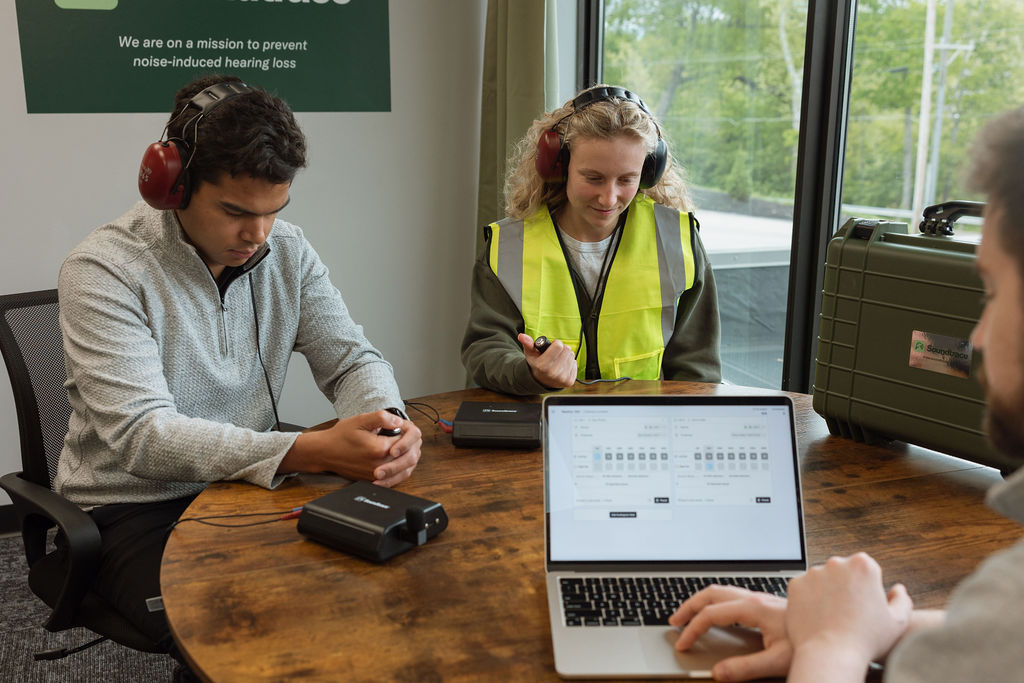
Hearing tests designed to meet OSHA 1910.95 requirements in about six minutes, at your facility, on your schedule. The Invisible Booth™ monitors ambient noise continuously, so results stay valid without a sound booth.
~6 min
avg. test time
Reviewed
OSHA 1910.95 Aligned
Independent 1910.95 Audit
Third-Party Reviewed

FDA Registered
Class II Medical Device
SOC 2 Type II
AICPA Certified

HIPAA Compliant
Powered by Vanta

Made in USA
Engineered & Built
Chapter 01
The Old Way Is Quietly Expensive
Vans, clinics, tablets, spreadsheets. It technically works, and it costs more than anyone is tracking.
Why Teams Switch · Beyond the Van
Why Employers Are Replacing Mobile Van Audiometric Testing
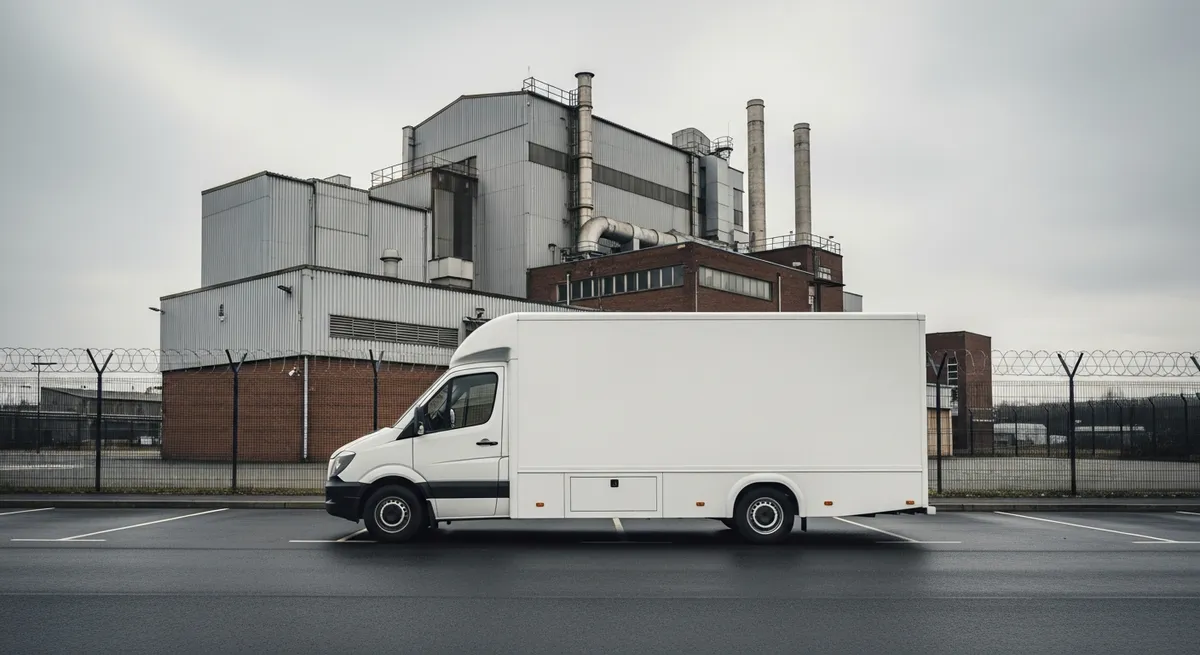
Mobile hearing test vans served their purpose, but a once-a-year visit no longer fits modern operations. Here is why safety teams are moving to always-available, in-house audiometric testing.
Always Available
A mobile audiometry van comes once or twice a year. In-house testing is ready every day, so new hires, night shifts, and missed employees get tested when it works for you, not months later.
Better Compliance
No more chasing employees who were absent on van day. Year-round access to portable audiometric testing closes the completion gaps that lead to OSHA citations.
Faster Testing
About six minutes per employee at your facility, instead of 15 to 30 minutes of van wait time. Test a few people during shift changes without disrupting production.
Earlier Shift Detection
Annual van visits can leave a hearing shift undetected for up to a year. always-available testing flags threshold shifts the moment a test completes.
Lower Lifetime Costs
No van rental fees, travel charges, or rescheduling penalties. Predictable per-employee pricing typically costs less over the life of your hearing conservation program.
Field Report
How one EHS Director stopped chasing clinic slots and secured a 33% ROI.
When you oversee safety for 2,000 people across seven industrial sites, you don't have time for a fragmented hearing conservation program. But that's exactly what this EHS Director inherited.
Half the workforce was being sent to off-site clinics - which meant finding coverage, paying for travel time, and losing about two hours of production per person. The other half was tested using a tablet that lacked clinical oversight. Records were scattered across three different systems. When leadership asked if they were fully compliant, the answer took days to pull together.
The hidden bill for "it works"
When they audited the true cost of their patchwork program, they discovered a glaring insight: the testing itself was the smallest part of the bill. The real expense was disguised as lost operational time.
Travel & Lost Work Time
~60%
1,000 clinic visits, ~2 hours off the floor each
Clinic Fallback Visits
~25%
Re-tests, absentees, shift mismatches
Mobile Van & Providers
~10%
Annual parking lot events
Program Administration
~5%
Scheduling, records, vendor wrangling
The turning point
They stripped out the clinics, the third-party tablet, and the scattered spreadsheets. In their place: one Soundtrace system deployed to all seven sites.
Now, safety managers run tests on their own schedule - any day, any shift, without leaving the facility. Every audiogram is automatically routed to a licensed audiologist for review, with threshold shifts flagged instantly. They added quantitative HPD fit testing into the exact same workflow. And when leadership asks about compliance, the EHS Director opens a single dashboard showing the live status of all 2,000 employees.
33%
Return on Investment
Achieved in the first year alone
Compound Savings
Program costs decrease every year the system runs, while compliance visibility remains absolute.
Name withheld at the customer's request.
Get PricingChapter 02
How Boothless Testing Actually Works
Six minutes per test, anywhere in your facility, with the sound booth replaced by continuous environmental verification.
A booth controls the environment.
Soundtrace verifies the environment.
OSHA doesn't require a sound booth — they require that ambient noise doesn't interfere with testing accuracy. The Invisible Booth™ measures room conditions in real time, so results are valid without the box.
Continuously Measured
A calibrated mic reads room noise every second.
Ambient Cap Checked
Compared instantly against one established ambient-noise cap.
Auto-Paused
If noise spikes, the test pauses until it clears.
Stored as Proof
Noise levels are saved directly onto the audiogram.
Continuous Monitoring
Calibrated microphone measures ambient noise throughout the entire test
Ambient Cap Checked
Room noise is compared against one established cap in real time
Automatic Pause & Resume
Testing pauses when noise exceeds the cap and resumes when clear
Documented & Stored
Ambient noise conditions permanently recorded with every audiogram
The separately calibrated Class 2 system monitors room noise continuously. Soundtrace uses one established ambient-noise cap: when the cap is exceeded, testing automatically pauses and resumes after conditions improve. Ambient noise can be reviewed alongside each recorded hearing threshold.
Technical reference
Review Soundtrace Audiometer hardware, ambient-noise, offline, and calibration specifications.
A detailed, crawlable technical reference for EHS, procurement, and clinical stakeholders.
How Soundtrace Works
The Fastest Test.
The Most Efficient Throughput.
A complete clinical workflow in about 6 minutes per employee. Independently documented by Purdue University in The Hearing Journal, test time fell from roughly 30 minutes to just 6 after switching to Soundtrace. Every test flows through a supervised workflow with Soundtrace acting as your professional supervisor.
One Facilitator. Four Stations.
150+ Employees a Day.
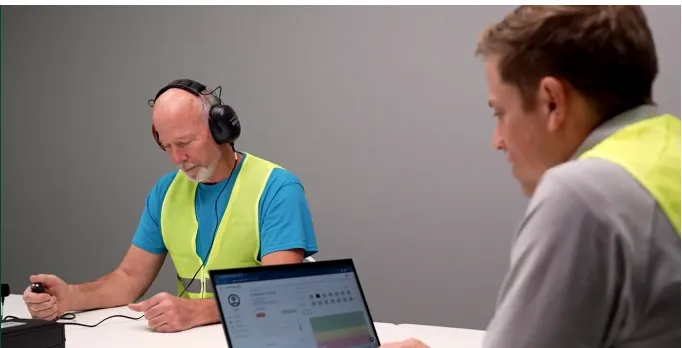
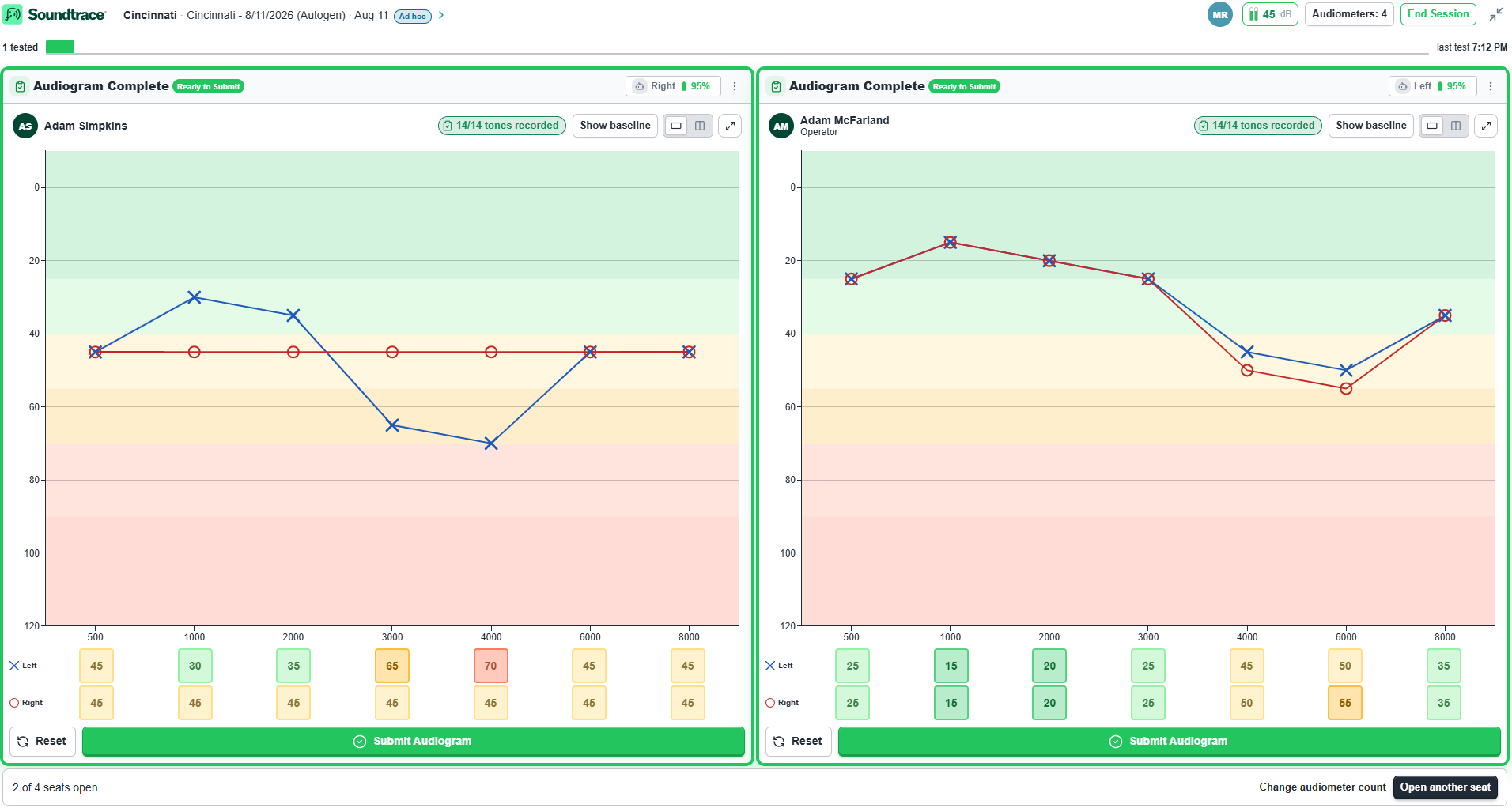
Traditional one-at-a-time testing turns annual audiograms into a multi-day project. With Soundtrace, one safety manager pairs up to four calibrated audiometers to a single tablet or PC.
A group of four employees finishes their test in about 10 minutes. As one group steps away, the next steps in. That keeps hourly throughput at 20+ employees per hour with just one facilitator. Plan for 150+ employees a day, with actual throughput depending on scheduling, setup, and employee needs.
0 min
Per Group of 4
0+
Employees / Hour
The 6-Minute Clinical Workflow
Managed Clinical Infrastructure. Soundtrace isn't just an audiometer. It's a complete workflow where your trained team member administers the test, and Soundtrace's licensed audiologists act as your program's professional supervisor.
Pre-Test Questionnaire
~1 min
Digital health history, noise exposure, and medications - captured before the test begins.
Automated Hearing Test
~4 min
All standard frequencies tested with calibrated headphones. Room noise monitored continuously.
Hearing Change Detection
Instant
Results compared against baseline the moment the test completes. Shifts flagged automatically.
Acknowledge & E-Sign
~1 min
Employee reviews results, signs digitally, and walks away. Records stored 30+ years.
Audiologist Review
Within 24 hrs
Chapter 03
Don't Take Our Word for It
Independent OSHA alignment review, field-proven accuracy, and licensed audiologists supervising every test.
Can You Trust Boothless Testing? Yes. Here's the Proof.
Meets OSHA 29 CFR 1910.95 and ANSI S3.1
Independently audited by Scott Ketcham, former Director of OSHA's Directorate of Enforcement Programs.
0%
Accuracy in the field
0+
Real-world audiograms
0+
Users
0+
Devices
Professional Oversight
OSHA Requires Professional Supervision. Ours Is Built In.
Under 29 CFR 1910.95, your audiometric testing program must be supervised by an audiologist, otolaryngologist, or physician. Most testing vendors leave that to you. With Soundtrace, professional supervision is part of the service, not a separate contract you have to source.
What OSHA requires, handled
Program supervision. Soundtrace acts as the Professional Supervisor of your audiometric testing program under 29 CFR 1910.95(g)(3).
Problem audiogram review. Every flagged audiogram is reviewed by a licensed audiologist, as 1910.95(g)(8) requires.
STS determinations and baseline revisions. The reviewing professional confirms or revises standard threshold shifts and advises on baseline revision.
Referral and notification support. Follow-up recommendations, medical referrals, and documentation that keeps you inside OSHA's 21-day employee notification window.
Beyond the requirement
Program guidance. Your team gets a clinical partner, not just a reviewer: guidance on hearing protection selection, retest strategy, and what your noise exposure data means for the program.
Employee education. Findings come back in plain language employees can act on, supporting the annual training OSHA expects and turning test day into an education moment.
Better employee experience. Workers get answers about their hearing instead of a form in a file: what changed, what it means, and what to do next.
A program that improves. Trends across years and locations feed recommendations, so supervision compounds into a stronger hearing conservation program over time.
Buying testing without supervision leaves the obligation with you. Many audiometric testing options stop at the test itself, which means finding and paying a supervising professional separately. Soundtrace includes it because a supervised program is the difference between collecting audiograms and actually protecting hearing.
CMO Oversight
Dr. Subinoy Das serves as Soundtrace's Chief Medical Officer, overseeing all clinical protocols, audiologist training standards, and testing methodology. His leadership ensures that every test across the platform meets the highest clinical standards - not just OSHA minimums.
Dr. Subinoy Das, CMONationwide Audiologist Network
Every audiogram is reviewed by a licensed audiologist through Soundtrace's nationwide professional network. Problem audiograms - hearing changes, unusual configurations, clinically significant shifts - are prioritized for expedited review and actionable recommendations.
Licensed Professional ReviewHearing Change Review Workflows
When a hearing change is detected, the audiologist evaluates clinical significance, determines work-relatedness, recommends follow-up actions (retest, medical referral, hearing protection refit), and documents everything in the system - ensuring you meet OSHA's 21-day notification timeline and 300 Log recordability requirements.
21-Day Notification Tracking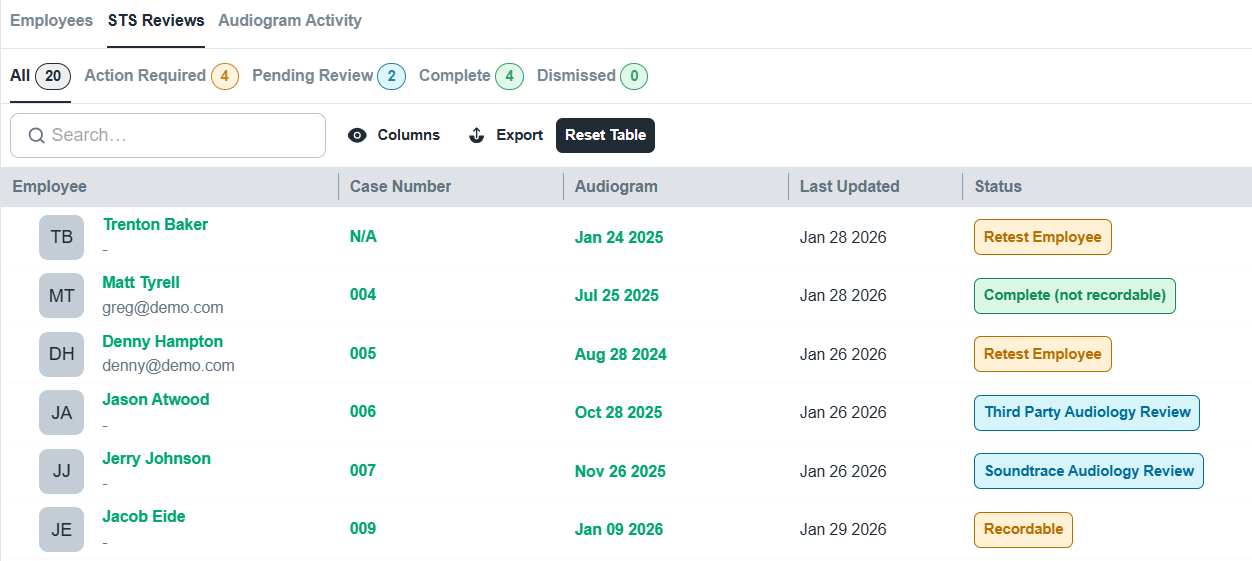
The STS review queue: flagged audiograms are prioritized for audiologist review.
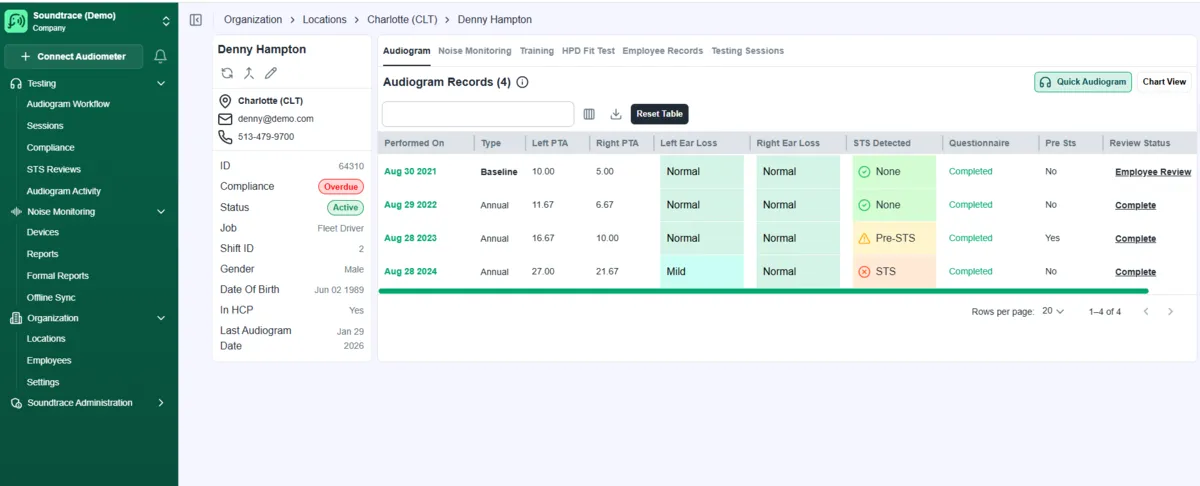
Every employee profile keeps the full audiogram history and baseline comparisons in one place.








"Soundtrace has revolutionized our hearing testing by streamlining the process and significantly reducing overall program costs."
Joe K.
EHS Manager
"Soundtrace has given us the flexibility to do Audiometric testing around our busy production schedule. With a great support team to help get the job done!"
Tyler L.
Safety Manager
"Soundtrace has completely changed how we handle hearing testing. 10/10 experience."
Bob H.
VP of Ops
"Soundtrace resolved the challenge of coordinating testing across three shifts."
Kevin G.
Safety Manager
Chapter 04
Make the Switch
Compare the alternatives, map out your testing schedule, and calculate your return on investment.
Why Teams Switch · Side-by-Side
How Soundtrace Compares
See why companies are switching from traditional audiometric testing methods to always-available in-house testing.
Scheduling flexibility
Soundtrace
Any day, any shift, during onboarding
Mobile Vans
1–2 available dates per year, months in advance
Setup time
Soundtrace
Always ready - no setup needed
Mobile Vans
Van setup and teardown each visit
Test duration
Soundtrace
~6 minutes per employee
Mobile Vans
15–30 minutes (including wait time)
Sound booth required
Soundtrace
No - Invisible Booth™ ambient monitoring
Mobile Vans
Yes - portable booth in the van
Results available
Soundtrace
Immediately, with automatic hearing change detection
Mobile Vans
Days to weeks for report delivery
Missed employees
Soundtrace
Test anytime - no rescheduling needed
Mobile Vans
Wait until next annual visit
Cost model
Soundtrace
Predictable per-employee pricing
Mobile Vans
Van rental + per-test + travel fees
Records retention
Soundtrace
Digital, 30+ year automatic retention
Mobile Vans
Paper files you manage and store
Why Teams Switch · Schedule Flexibility
Test on Your Schedule, Not a Van's
See how testing cadence impacts completion rates, compliance gaps, and operational disruption.
Choose a Testing Cadence
Compare how scheduling frequency affects your program outcomes
Annual (Mobile Van)
1–2 day van visit per year
Traditional approach: coordinate schedules months in advance, pull everyone off the floor on van day, pay premium rates for anyone who was absent.
117
Employees tested
33
Missed / non-compliant
78%
Completion rate
4.5 months
Avg wait for new hires
Missed Employee Catch-Up
Reschedule van or wait until next year
Compliance Risk Level
High - single point of failure
Hearing Change Detection Delay
Up to 12 months - A full year of potential hearing damage before the next test detects it.
With 33 employees missing their annual test, each one is a potential OSHA citation at up to $15,625 per violation. That's up to $515,625 in potential fines - plus the workers' comp exposure from undocumented hearing changes.
Ready to leave the van behind?
Equip your safety team with always-available testing infrastructure. OSHA 1910.95 alignment, clinical review, and perfect records — built right in.
Frequently Asked Questions
The details on compliance, clinical review, and moving away from mobile vans.
Is boothless testing really OSHA 1910.95 aligned?
Who can administer the tests?
What happens when an STS is detected?
How does this compare with mobile vans?
What does implementation look like?
Related Resources
Continue exploring the Soundtrace platform
Noise Monitoring
Continuous dosimetry that pairs with audiometric data to build a complete exposure profile.
Learn moreHPD Fit Testing
Verify real-world hearing protection after every audiogram with REAT-based fit testing.
Learn moreRecordkeeping
30-year digital retention for all audiometric records, shift reports, and compliance logs.
Learn moreCase Studies
See how organizations reduced costs and improved compliance with Soundtrace.
Learn moreIndustry Solutions
Learn how food production, heavy equipment, and metals fabrication teams use Soundtrace.
Learn moreBlog
OSHA guidance, STS detection best practices, and hearing conservation research.
Learn moreOSHA Standard Threshold Shift Guide
What counts as an STS, how it is calculated, and what employers must do when one is detected.
Learn moreTemporary vs. Permanent Threshold Shift
How to tell a temporary shift from permanent hearing loss and why retesting timing matters.
Learn more4000 Hz Notch & Noise-Induced Hearing Loss
Why a dip at 4000 Hz is the earliest telltale sign of noise-induced hearing loss.
Learn moreReady to Simplify Audiometric Testing?
See how in-house, boothless audiometric testing can replace mobile van visits and give you year-round compliance confidence.