

Workers' compensation for occupational hearing loss is a known, quantified exposure. Employers in noise-hazardous industries budget for it, defend against it, and document audiometric records specifically to limit it. What almost no employer has calculated is the share of their non-hearing WC claims — their falls, fractures, TBIs, and musculoskeletal injuries — that are partially attributable to the hearing impairment sitting in their workforce. That number is not zero. For many industrial employers, it may be larger than the hearing loss WC exposure they are already defending against.
Soundtrace delivers in-house audiometric testing and noise monitoring with automated STS detection and licensed audiologist review — so your hearing conservation program protects hearing and reduces downstream injury WC exposure.
- The cost accounting problem in occupational safety
- Falls as the dominant WC cost driver
- The hearing loss multiplier in the fall cost model
- The calculation framework
- What changes about the hearing conservation ROI argument
- The experience modification rate multiplier
- What this means for program investment decisions
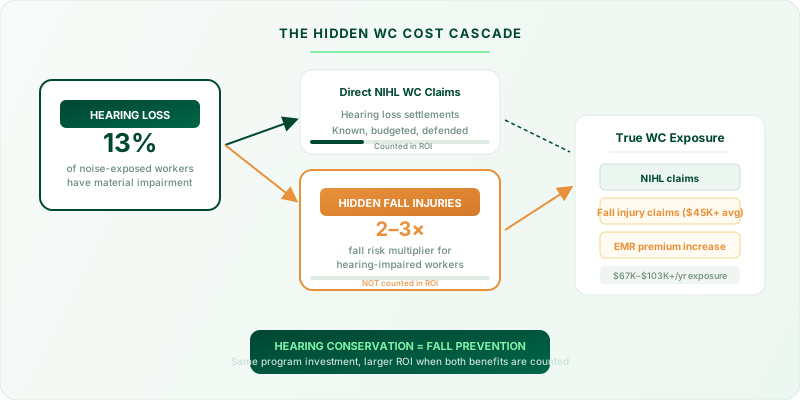 The WC cost cascade: hearing impairment drives fall injury claims that are never attributed to the hearing conservation program.
The Cost Accounting Problem in Occupational Safety
When a worker with OSHA-documented hearing impairment falls on a production floor and fractures their wrist, the WC claim is coded as a musculoskeletal injury. It joins the fracture and sprain bucket of the OSHA 300 log. It feeds the EMR calculation under the musculoskeletal injury category. It is handled by WC defense counsel who specializes in orthopedic injuries, not hearing loss. The hearing conservation program gets no credit for having partially prevented it — and gets no blame for not having prevented it more effectively.
This cost accounting gap means that the ROI of hearing conservation programs is systematically underestimated by employers, insurers, and EHS budget committees. The avoided NIHL claim is counted. The avoided fall injury is not. But the research base now makes clear that the two are connected — and quantifiably so.
Falls as the Dominant WC Cost Driver
The National Safety Council reports that falls to the same level and falls to a lower level are consistently among the top three causes of both occupational fatalities and non-fatal injuries in the United States. The Bureau of Labor Statistics data on WC costs confirms: fall injuries generate disproportionately high claims because they produce serious physical consequences. A fall that results in a hip fracture, TBI, or spinal injury generates a WC claim measured in the six figures. Average serious fall injury WC costs across industrial sectors typically range from $40,000 to well over $100,000 when medical treatment, lost-time wages, and permanent impairment benefits are included.
In manufacturing, the National Safety Council's injury cost data consistently shows falls and overexertion as the two dominant WC claim drivers by total cost. These are not edge cases or outliers — they are the core WC cost problem for most industrial employers.
The Hearing Loss Multiplier in the Fall Cost Model
The research connection is now established by a substantial and growing literature. Key findings:
- Lin and Ferrucci (2012, Archives of Internal Medicine): Mild hearing loss associated with a three-fold increase in fall odds. Risk increases approximately 140% for each additional 10 dB of hearing loss.
- Systematic review and meta-analysis (2025, PMC): Hearing loss associated with 51% greater cross-sectional odds of falls across 27 studies and more than 5 million participants. Association held after adjusting for vestibular dysfunction, vision impairment, and other fall risk factors.
- Girard et al. (2015, Injury Prevention): In a directly occupational cohort, severe noise-induced hearing loss was associated with falls leading to hospitalization (OR 1.97). This is a study of retired industrial workers with 30+ year noise exposure careers.
- CDC/NIOSH directly states: Workers with hearing loss are more likely to get injured on the job.
What this means in cost terms: if 13% of your noise-exposed workforce has material hearing impairment (the NIOSH industry average), and workers with mild impairment have approximately three times the fall odds of workers with normal hearing, then a meaningful share of your annual fall injury WC claims are partially attributable to the hearing impairment in your workforce.
The exact attribution is not calculable from published research alone — it requires facility-specific audiometric data and WC claims data. But the directionality is clear, and the magnitude is not trivial.
The Calculation Framework
EHS directors and safety managers can construct a rough estimate of this exposure using their own data:
| Input | Data Source | Example (Facility A) |
|---|---|---|
| Total enrolled workers | Audiometric program records | 300 workers |
| % at mild impairment or above (better ear ≥26 dB HL) | Current audiometric records | 15% = 45 workers |
| Baseline fall injury rate (per 100 workers/year) | OSHA 300 log, 5-year average | 3.2 per 100 = ~9.6 injuries/yr |
| Estimated elevated fall rate for hearing-impaired workers | Apply 2-3× multiplier to baseline | ~6.4–9.6 per 100 for impaired workers |
| Attributable additional falls from impaired subgroup | Difference × impaired worker count | ~1.5–2.3 additional injuries/yr |
| Average serious fall injury WC cost | Insurer/TPA data or NSC estimate | $45,000 |
| Annual attributable WC exposure from impaired subgroup | Additional falls × avg cost | $67,500–$103,500/yr |
This is a simplified model with significant uncertainty in each step. The actual relationship between hearing impairment and fall injury at any specific facility depends on the physical environment, job demands, HPD use, and dozens of other variables. But the model illustrates the order of magnitude of the exposure — and for most mid-size industrial employers, the output is a number that materially exceeds the direct NIHL WC exposure they are already managing.
What Changes About the Hearing Conservation ROI Argument
The conventional hearing conservation ROI argument runs as follows: the program costs X per year; it prevents Y NIHL WC claims at Z average cost; the ROI is (Y×Z)/X. For most programs, this calculation is positive but not dramatic, because NIHL WC claims per facility per year are relatively small in number even when individually expensive.
Adding the fall injury WC connection changes the calculation substantially:
- The avoided claim base expands. You are no longer counting only hearing loss WC claims. You are counting the portion of fall injury WC claims attributable to hearing impairment in your workforce. That is a larger number at most facilities than the NIHL claim base.
- The prevention mechanism is the same. The same hearing conservation activities that prevent NIHL — early STS detection, effective HPD programs, noise engineering controls — also maintain workers at lower hearing threshold levels where fall and injury risk is lower. There is no additional program investment required to capture this benefit; it is a co-benefit of doing the existing program well.
- The severity of avoided claims may be higher. A serious fall injury resulting in fracture, TBI, or permanent impairment generates a larger WC claim than the average NIHL settlement. Preventing even one serious fall injury per year from an improved hearing conservation program can shift the ROI calculation significantly.
The Experience Modification Rate Multiplier
WC claims feed the employer's experience modification rate (EMR) for three years after the claim year. A $60,000 fall injury claim at a mid-size manufacturer can increase the EMR by 0.08–0.15 points, translating to 8–15% higher WC premiums for three years. At $600,000 in annual WC premium, that is $48,000–$90,000 in additional premium cost from a single claim, on top of the direct claim settlement.
The hearing conservation program's contribution to preventing fall injuries feeds into the EMR through that same mechanism — meaning the premium reduction benefit of avoided fall claims adds a third layer to the ROI calculation beyond the direct claim cost and the hearing loss claim avoided.
What This Means for Program Investment Decisions
The hearing loss → fall/injury risk connection has direct implications for how EHS directors and safety managers should frame hearing conservation program investment decisions:
Hearing conservation is fall prevention infrastructure. The audiometric testing program that maintains workers at lower threshold levels is simultaneously maintaining them at lower fall risk. The HPD program that prevents progressive NIHL is also slowing the accumulation of workers at the mild-impairment threshold where fall risk triples. These are not separate programs producing separate benefits — they are the same program producing two categories of benefit that most organizations are only counting once.
The audiometric data needs to be readable as a safety risk metric. Capturing the fall injury WC co-benefit in your ROI analysis requires knowing what percentage of your workforce is currently at mild impairment or above, and tracking whether that rate is improving. That analysis requires complete, current, per-worker audiometric records in an accessible format. A mobile van program with records in a vendor's proprietary system cannot produce this analysis. An employer-controlled cloud platform with per-worker threshold history can. See: What Your Workforce's Audiogram Distribution Reveals About Safety Risk.
The full ROI argument changes the budget conversation. When an EHS director presents the hearing conservation program budget to operations or finance, the conventional argument is OSHA compliance cost avoidance plus NIHL WC defense. The expanded argument includes: compliance cost avoidance, NIHL WC defense, fall injury WC reduction from maintaining workforce hearing health, and EMR improvement from reduced fall claims. That argument is materially stronger — and it is grounded in research that is published, peer-reviewed, and directly cited by NIOSH. See also: Hearing Loss and Workplace Fall Risk: What Your Audiometric Data Is Telling You.
- 29 CFR 1910.95 — OSHA Occupational Noise Exposure Standard
- CDC/NIOSH: About Occupational Hearing Loss
- NIOSH Occupational Hearing Loss Surveillance: Overall Statistics
- Hearing Loss and Falls Among Older Adults in the United States — PMC/NIOSH
- Hearing Loss and Falls: Systematic Review and Meta-Analysis (2025) — PMC
- Hearing Impairment Among Noise-Exposed Workers, 2003–2012 — CDC MMWR
- Girard et al. (2015): Occupational Noise and Work-Related Injuries Leading to Hospitalization — Injury Prevention
Hearing conservation is your strongest injury prevention investment
Understand the full business case — compliance, WC defense, and fall injury risk reduction — in our complete guide.
See the Full ROI Case → Get a Free Quote- Hearing Loss and Workplace Fall Risk: What Your Audiometric Data Reveals
- Audiometric Data: Workforce Safety Risk Analysis
- Workers Compensation for Occupational Hearing Loss: The Complete Employer Guide
- The True Cost of Occupational Hearing Loss to Employers
- The Business Case for Hearing Conservation: ROI Beyond OSHA Compliance