

OSHA 29 CFR 1910.95 requires annual audiometric testing to detect hearing threshold changes. Most EHS programs treat those audiograms as a compliance record and a workers' compensation defense document. They are both of those things. But they are also something else: a leading indicator of your workforce's fall and injury risk that almost no safety program is currently reading.
Soundtrace delivers in-house audiometric testing with automated STS detection and licensed audiologist review — giving EHS directors the per-worker and facility-level hearing data needed to identify and address fall risk in their workforce.
What the Research Actually Says
The connection between hearing loss and fall/injury risk is not theoretical. CDC/NIOSH states directly: workers with hearing loss are more likely to get injured on the job. The research base supporting that statement is now substantial.
A 2025 systematic review and meta-analysis published in PMC examined 27 studies covering more than 5 million participants. The pooled finding: hearing loss is associated with a 51% greater cross-sectional odds of falls compared to normal hearing, and a 17% greater longitudinal risk of falls over time. These associations held even after adjusting for concurrent risk factors including vision impairment and vestibular dysfunction.
The landmark study by Lin and Ferrucci, published in the Archives of Internal Medicine and widely cited by NIOSH, found that mild hearing loss alone is associated with a three-fold increase in the odds of falling. The risk increases with severity: each additional 10 dB of hearing loss corresponds to roughly a 140% increase in fall risk in their cohort. This is not a marginal effect. A worker with mild hearing loss (26–40 dB HL) has meaningfully elevated fall risk compared to a worker with normal thresholds.
Girard et al. (2015), published in Injury Prevention, examined this relationship specifically in occupational settings. Their finding: occupational noise-induced hearing loss is associated with work-related injuries leading to hospitalization. The study analyzed retired workers with average occupational noise exposure of 30.6 years and found a statistically significant relationship between severe NIHL and hospitalized falls (OR 1.97).
Three Mechanisms That Explain the Link
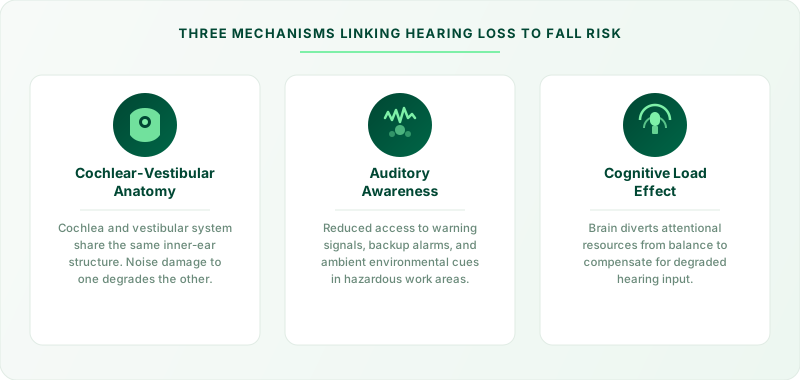 Three physiological and cognitive pathways through which hearing loss elevates fall risk in industrial workers.
The hearing loss → fall/injury connection is not a statistical artifact. There are three well-supported physiological and cognitive mechanisms that explain it:
1. Cochlear-Vestibular Anatomy
The cochlea (hearing) and the vestibular system (balance) share the same bony labyrinth structure in the inner ear and share neural pathways to the brain. Noise-induced damage to the cochlea does not occur in complete isolation from vestibular function. Research consistently finds subclinical vestibular dysfunction co-occurring with cochlear hearing loss in noise-exposed workers, even when traditional vestibular testing does not flag overt vestibular disorder. The balance system is operating with compromised input.
2. Auditory Environmental Awareness
Hearing loss reduces a worker's access to auditory cues that are essential for environmental awareness in industrial settings. The warning beep of a reversing forklift. The approaching footsteps of a co-worker around a blind corner. The change in sound that signals a mechanical process has shifted from normal to abnormal. The ambient audio landscape of a manufacturing floor is densely informative for workers with normal hearing — and progressively inaccessible as hearing thresholds rise. Workers with hearing loss are navigating a physically hazardous environment with less real-time environmental information.
3. Cognitive Load and Attentional Resources
This is the most underappreciated mechanism. Maintaining postural balance and avoiding falls requires continuous, real-time attentional resources from the brain. When hearing loss forces the brain to work harder to process speech and environmental sounds — filling in missing frequencies, context-guessing muffled communications, concentrating intensely to understand verbal instructions — attentional resources are diverted. Research by Lin and Gordon-Salant, among others, demonstrates that the cognitive load imposed by hearing loss measurably reduces the attentional resources available for postural control. This is why the hearing loss → fall risk association appears even in controlled studies that adjust for vestibular function: you can have an intact vestibular system and still fall more because your brain is cognitively overloaded by the effort of hearing.
What the NIOSH Surveillance Data Shows About Your Workforce
The NIOSH Occupational Hearing Loss Surveillance Project analyzed 1,413,789 audiograms from 25,908 U.S. companies during 2003–2012. The overall finding: 13% of noise-exposed tested workers have material hearing impairment. In the mining sector it is 17%. Construction: 16%. Manufacturing: 14%.
The WHO/Global Burden of Disease audiometric definitions used in that analysis define hearing impairment categories as follows:
| Category | Better-Ear Threshold (dB HL) | Classification | Known Fall Risk Association |
|---|---|---|---|
| Normal | <26 dB | No impairment | Reference (1.0×) |
| Mild impairment | 26–40 dB | Slight hearing difficulty | ~3× increase in fall odds (Lin & Ferrucci) |
| Moderate impairment | 41–60 dB | Difficulty in noisy settings, some quiet | Significantly elevated; 140% increase per 10 dB |
| Moderately severe | 61–80 dB | Difficulty in most settings | Highest injury hospitalization risk (Girard et al.) |
| Severe or profound | >80 dB | Hearing aid or CI range | Severe; OR 1.97 for falls leading to hospitalization |
If your facility has 200 enrolled workers and follows the NIOSH industry average, roughly 26 of them have some degree of hearing impairment right now. The audiometric data to identify which workers and at what severity level exists in your records — if you have a complete, per-worker audiometric surveillance program.
The Industrial Setting Makes the Risk Worse
The hearing loss → fall risk research base is predominantly from general population and occupational cohort studies. The manufacturing and industrial workplace amplifies these risk factors in several ways that the research does not fully capture:
- Physical hazard density is higher. A worker with mildly elevated fall risk in a quiet office faces different consequences than the same worker on a production floor with moving equipment, elevated walkways, loading docks, and machinery.
- Warning signal dependence is higher. Industrial environments depend heavily on auditory warning systems — backup alarms, process alarms, verbal safety communications — that hearing loss directly degrades.
- Cognitive load is higher. A noisy production floor imposes hearing effort burden simultaneously with physical task demands, compounding the attentional resource depletion that the research identifies as a fall risk mechanism.
- Hearing protection creates its own awareness trade-off. Workers wearing HPD gain noise attenuation at the cost of further reduced environmental awareness. This is an acceptable trade-off when HPD is the right protective measure — but it is an additional layer on top of already-impaired hearing in workers with NIHL.
What This Means for Your HCP Program Design
The hearing loss → fall/injury risk link has three direct implications for how EHS programs should use audiometric data:
1. Workers with identified STSs are also elevated-injury-risk workers. When your Professional Supervisor identifies a Standard Threshold Shift, the immediate OSHA-required response is HPD refitting and notification. The broader safety response should also include awareness of elevated fall/injury risk for that worker, particularly if their cumulative threshold profile now reaches mild impairment. The STS flag is not only a hearing health event — it is a safety risk inflection point.
2. Pre-employment audiograms capture more than WC baseline. A new hire presenting with pre-existing mild hearing impairment at hire is not just a WC baseline documentation event. That worker has an existing elevated fall and injury risk profile that is relevant to job placement, task assignment, and safety supervision decisions.
3. The facility's aggregate audiometric profile is a safety risk metric. A facility where 18% of enrolled workers are at mild impairment or above has a measurably different safety risk profile than a facility where 6% are. Both may be fully OSHA 1910.95 compliant. Only one can see this risk differential in their audiometric data — and only if the data is complete, current, and accessible in a format that allows aggregate analysis. See: What Your Workforce's Audiogram Distribution Reveals About Safety Risk.
The Underrecognized WC Connection
Falls are the leading cause of occupational fatalities in construction and a top cause of WC claims across manufacturing. If hearing loss is a 2–3x fall risk multiplier, then workers with occupational hearing impairment are disproportionately represented among your slip/trip/fall WC claimants — not as hearing loss claims, but as musculoskeletal injuries, fractures, and TBIs. The hearing conservation program that prevents NIHL also partially prevents these downstream injury claims. That connection is almost never made explicit in the safety literature or in EHS program design. See: The Hidden WC Connection: How Hearing Loss Drives Non-Hearing Injury Claims.
- 29 CFR 1910.95 — OSHA Occupational Noise Exposure Standard
- CDC/NIOSH: About Occupational Hearing Loss
- NIOSH Occupational Hearing Loss Surveillance: Overall Statistics
- Hearing Loss and Falls Among Older Adults in the United States — PMC/NIOSH
- Hearing Loss and Falls: Systematic Review and Meta-Analysis (2025) — PMC
- Hearing Impairment Among Noise-Exposed Workers, 2003–2012 — CDC MMWR
- Girard et al. (2015): Occupational Noise and Work-Related Injuries Leading to Hospitalization — Injury Prevention
Hearing conservation is your strongest injury prevention investment
Understand the full business case — compliance, WC defense, and fall injury risk reduction — in our complete guide.
See the Full ROI Case → Get a Free Quote- Hearing Loss and Workplace Accident Risk: Why Hearing Conservation Is Injury Prevention
- The Health Effects of Occupational Noise Beyond Hearing Loss
- Hearing Loss and Cognitive Decline: Employer and Productivity Guide
- The Hidden WC Connection: How Hearing Loss Drives Non-Hearing Injury Claims
- The Business Case for Hearing Conservation: ROI Beyond OSHA Compliance