
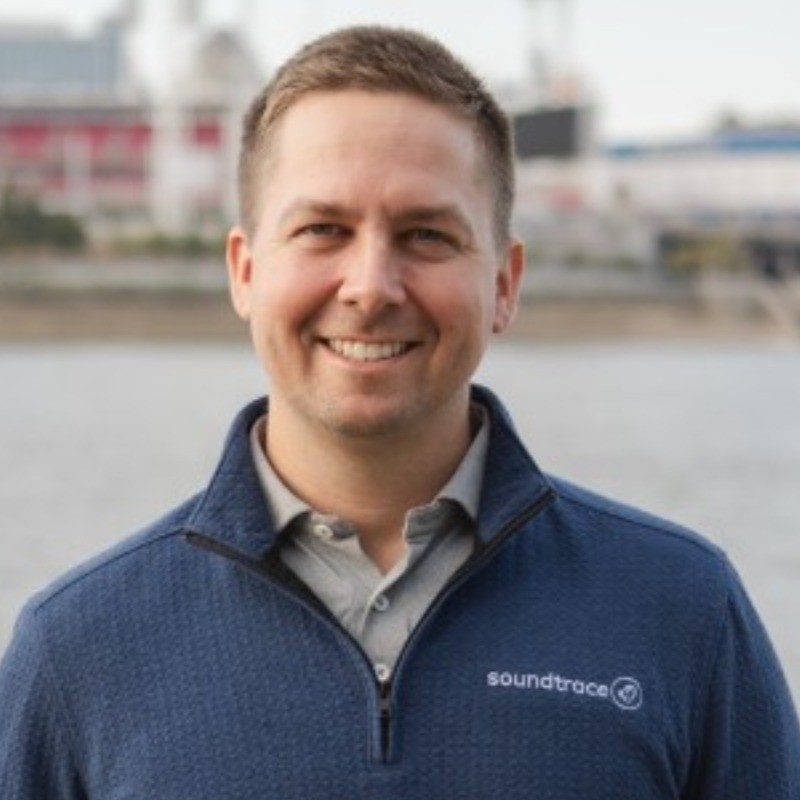
By
Jeff Wilson
Founder & CEO, Soundtrace
We hear some version of the same thing in nearly every sales conversation: "Off the record? We know it's loud in there. We just don't want to open a can of worms." It's an understandable instinct. It's also one of the most legally and financially dangerous positions an operations executive can hold.
Here's the problem with that logic: the can of worms is already open. Your workers know it's loud. Their hearing is already being affected. The only people currently in the dark are you, your legal team, and your insurance carrier. And that asymmetry of knowledge is not protecting you — it's exposing you.
This post is about why the "ignorance is bliss" approach to occupational noise has quietly become one of the highest-risk decisions in modern industrial operations — and why the science emerging around hearing loss has dramatically raised the stakes for employers who aren't paying attention.
What $6 Billion Taught Us About Documentation
3M Combat Arms Earplugs settlement — the largest mass tort in U.S. history
Source: Reuters / public court filings, 2023
Most people in industrial operations have heard about the 3M Combat Arms Earplugs litigation — the largest mass tort settlement in U.S. history at over $6 billion. The instinct is to dismiss it: that's a military case, a different world, a different set of circumstances.
But that instinct misses the actual lesson of the case. 3M didn't lose $6 billion because soldiers were exposed to loud noise. They lost it because internal documents showed they knew their product was defective and continued selling it anyway. The exposure wasn't the liability. The knowledge without action was the liability.
Not measuring doesn't create ignorance. In a courtroom, it creates willful ignorance — which courts treat far more harshly than a company that measured, found a problem, and addressed it imperfectly.
That distinction matters enormously in the industrial context. When a plaintiff attorney takes an occupational hearing loss case, they're not just asking "was it loud?" They're asking "what did the employer know, when did they know it, and what did they do about it?" The legal concept is called constructive knowledge — and it means that what you should have known is treated the same as what you did know.
Your industry peers were running hearing conservation programs. OSHA standards have required noise monitoring since 1971. You had workers operating heavy machinery for 20 years. Are you telling this jury you had no reason to believe noise was a problem?
No documentation doesn't answer that question. It makes it worse.
The Human Ear Is a Terrible Risk Assessment Tool
The second reason the "it's not that loud" position is so precarious is physiological. The human ear is genuinely, measurably unreliable as a gauge of dangerous noise exposure — and the workers most at risk are precisely the ones least likely to perceive it.
Noise-induced hearing loss is self-concealing. Early damage occurs in the high-frequency range around 4,000 Hz — outside the range of normal conversational speech. A worker can be losing meaningful hearing for years before they notice anything in daily life. By the time exposure feels dangerous, significant permanent damage has already occurred.
Compounding this: workers with the most tenure have the most adapted perception. A 20-year machinist doesn't think the floor is loud because their brain has recalibrated to it. They're not being dismissive — they genuinely cannot perceive the risk the way a fresh set of ears would. That's physiology, not negligence on their part.
OSHA's action threshold is 85 decibels. A lawnmower runs at roughly 90 dB. Most people wouldn't describe either as dangerously loud in an industrial context. But consistent exposure above 85 dB over a full shift is enough to trigger federal hearing conservation requirements — and enough to cause measurable, permanent cochlear damage over time.
Any safety program that relies on workers self-reporting "it feels too loud" is built on the least reliable sensor in the building. That's why the program standard was built around objective audiometric testing and continuous noise monitoring — not worker complaints.
The Three Rings of Cost
When operations executives think about the cost of occupational hearing loss, they typically think about one thing: workers' comp claims. That's Ring 1. It's real, it's significant, but it's the smallest part of the picture.
The Visible Cost
Workers' comp claims, OSHA citations and penalties, hearing protection program expenses. This is where most safety conversations start — and stop. The numbers are painful but predictable.
The Hidden Cost
Productivity loss from workers with degraded hearing — miscommunication, errors, slower response to verbal instruction. Turnover and retraining. Accommodation costs. Research consistently shows this layer runs 4–6x the direct claim cost.
The Emerging Cost
This is where the science has fundamentally changed the conversation — and where your liability for the next decade is being written right now, for claims that won't surface for another 10–15 years.
The Science That Changes Everything
The Lancet Commission on Dementia Prevention — synthesized by an international panel of leading researchers and published in one of the world's most respected medical journals — identifies hearing loss as the single largest modifiable risk factor for dementia. In its 2020 report and reaffirmed in the 2024 update, hearing loss carries an estimated 7–8% population attributable fraction for dementia globally — larger than any other modifiable factor the commission examined.
This wasn't a fringe finding. It was the synthesis of decades of longitudinal research, most prominently the work of Dr. Frank Lin and colleagues at Johns Hopkins, which found that mild hearing loss roughly doubles dementia risk, moderate loss triples it, and severe loss increases it nearly fivefold.
Increased dementia risk associated with severe hearing loss
Source: Lin FR et al., Archives of Neurology, 2011 / Johns Hopkins Cochlear Center for Hearing & Public Health
The ACHIEVE trial, published in The Lancet in 2023, went further — it was the first randomized controlled trial to demonstrate that intervening on hearing loss slowed cognitive decline by roughly 48% in older adults at higher risk for cognitive decline. Intervention works. Which means non-intervention is a choice with measurable consequences.
Slower cognitive decline when hearing loss is treated early in higher-risk adults
Source: Lin FR et al. (ACHIEVE trial), The Lancet, 2023
For an operations executive, this science reframes the entire conversation. You are no longer making decisions only about compliance costs and workers' comp premiums. You are making decisions about the long-term cognitive health of your workforce — and the downstream disability, healthcare, and potential liability exposure that comes with it.
What Documentation Actually Does For You
Here's the reframe that matters most for executives who've been avoiding the conversation: monitoring is not what opens the can of worms. The noise is already there. The exposure is already accumulating. What monitoring does is give you control over the narrative before someone else controls it for you.
A company that measures, finds elevated exposure, and implements a hearing conservation program has a defensible story. A company that never measured has no story at all — only the question of why they didn't look when they should have known to look. That's the heart of the analysis we walk through in our white paper, The Silent Liability.
Steel and auto manufacturers learned this the hard way across decades of litigation. The companies that fared best weren't the ones with the quietest facilities — they were the ones with the most rigorous documentation showing they took the issue seriously, monitored consistently, and acted on what they found. Even imperfect action, documented, is a defense. Inaction, documented by its absence, is not. (For more on the downstream health-cost framing, see our companion paper The Hidden Cost of Untreated Hearing Loss.)
The Bottom Line
The industrial workforce is aging. The cumulative noise exposure of workers who've been on your floor for 15 or 20 years is a liability that exists whether or not you've measured it. The science connecting that exposure to long-term cognitive consequences is no longer emerging — it's established, peer-reviewed, and in front of the world's largest medical journals.
The question for operations executives isn't whether to open the can of worms. It's whether you want to find out what's in it on your terms — with time to respond, document, and protect your workforce and your company — or on a plaintiff attorney's terms, a decade from now.
Measurement isn't the risk. It's the only thing that manages it.
Jeff Wilson, Founder & CEO, Soundtrace
Related Resource
Schedule a demo to see what your noise data looks like