
Hearing Conservation for
Cultivation, Extraction & Processing.
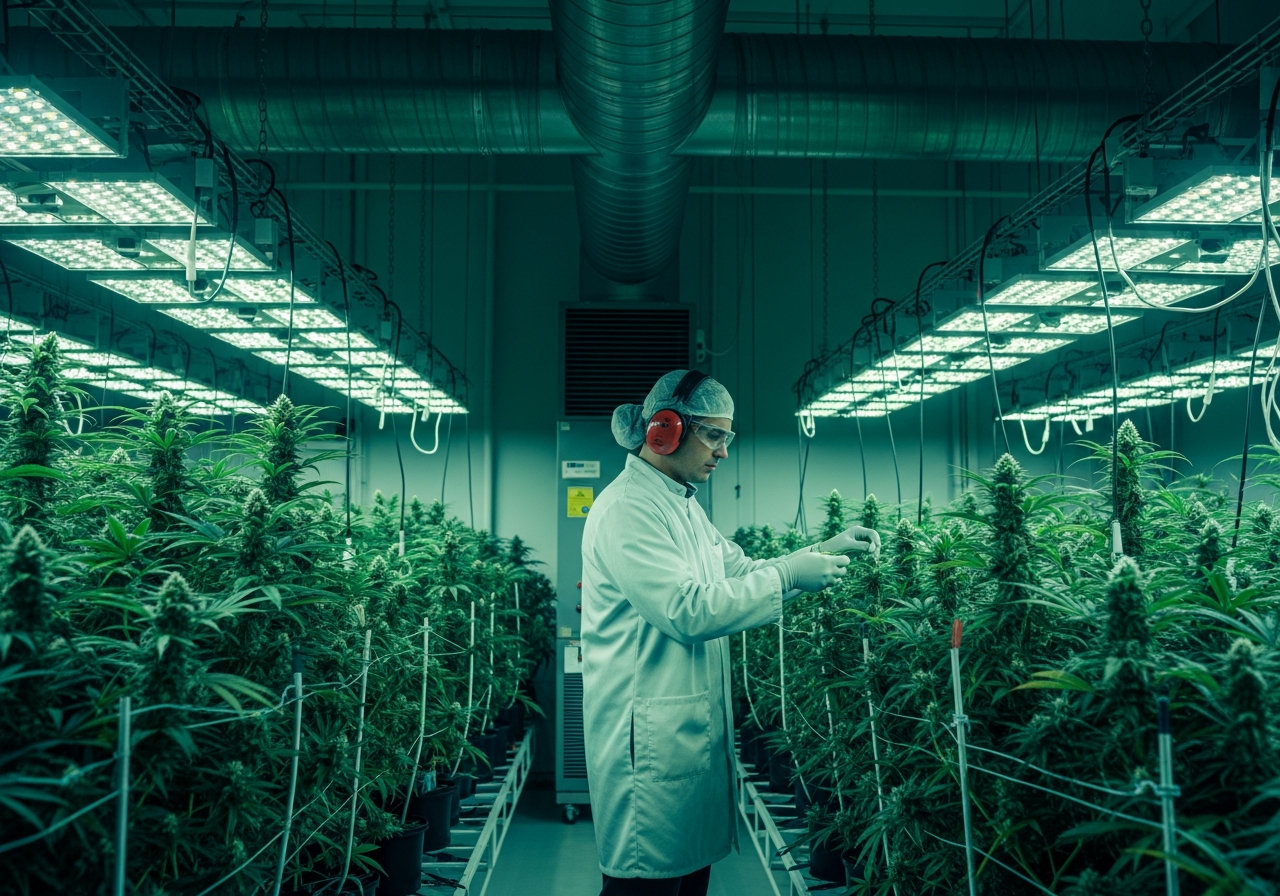
Trim mills hit 96 dBA. Extraction bays push 100. Cultivation HVAC never sleeps. The same OSHA standard that applies to traditional manufacturing applies to cannabis — most operators aren't ready.
92
dBA avg trim/mill
100
dBA peak extraction
50–80%
Trim crew turnover
440K+
U.S. cannabis workers
Independent 1910.95 Audit
Third-Party Reviewed
FDA Registered
Class II Medical Device
SOC 2 Type II
AICPA Certified
HIPAA Compliant
Powered by Vanta

Made in USA
Engineered & Built
The Reality on the Floor
Why Cannabis Is a Hidden Noise Hazard
Cultivation, extraction, and processing all run loud — and most operators built their compliance programs around state cannabis rules, not federal occupational safety.
Cultivation HVAC Runs Loud, 24/7
Indoor grows depend on dehumidifiers, exhaust fans, CO2 enrichment systems, and HID/LED ballasts that push grow rooms to 85–95 dBA. Trimming and cure rooms often add another 5–10 dBA on top.
Extraction and Post-Processing Are Loud Too
CO2 and hydrocarbon extractors, ethanol recovery pumps, vacuum ovens, and rotovaps are routinely above 90 dBA — with workers spending full shifts in confined extraction bays.
Hourly Trim and Pack Crews Turn Over Fast
Seasonal trimming, packaging, and harvest crews see 50–80% annual turnover. Baseline audiograms get skipped, and STS detection breaks down when records aren't continuous.
OSHA Applies — Even Where Cannabis Is Federally Restricted
Federal Schedule I status doesn't exempt operators from OSHA. State cannabis control boards and worker safety divisions are starting to cite hearing conservation gaps in license renewals.
Built for Your Operations
How Soundtrace Fits Into Cannabis Operations
Test Between Harvests Without a Van Visit
6 min
per test
6-minute in-house audiograms slot into shift changes. Test trim crews and packaging staff without disrupting production windows or harvest schedules.
Baseline Every New Trimmer on Day One
Day 1
baseline captured
Onboard seasonal labor and gig trim crews with a baseline audiogram before they hit the floor. Stay within OSHA's 6-month baseline window even with rapid hiring.
Verify HPD in Cultivation and Extraction
Real
NRR verification
Fit testing confirms actual attenuation in humid grow rooms and solvent-restricted extraction bays where standard foam plugs lose seal or aren't permitted.
Audit-Ready for State Regulators
30+
year retention
Centralized digital records ready for state cannabis control boards, OSHA, and your METRC-tied compliance reviews. 30+ year retention out of the box.
Know Your Exposure
Typical Noise Levels in Cannabis Operations
Trim rooms, extraction bays, and grow-room HVAC routinely exceed OSHA's 85 dBA action level — and packaging often does too.
Bucking machines, grinders, pre-rolls
Pumps, vacuum ovens, rotovaps
Dehumidifiers, exhaust fans, CO2 systems
High-speed cone fillers, sealers, labelers
Often excluded from monitoring
Below action level
How Loud Is That?
60 dB
Normal conversation
85 dB
OSHA action level
110 dB
Rock concert
OSHA ITA Data
A Growing Workforce, A Growing Exposure
Cannabis sector employment has grown rapidly across legal-state markets since 2018, expanding the population of workers exposed to processing and extraction noise.
440K+
U.S. Sector Workers
Cultivation, processing, retail
38
Legal-State Markets
Medical or adult-use programs
92
Avg Trim/Mill dBA
Above OSHA 85 dBA action level
Compliance Context
OSHA + State Cannabis Compliance
Cannabis operators answer to two safety frameworks at once — and gaps in one increasingly surface in the other.
OSHA 29 CFR 1910.95
Full hearing conservation program required: monitoring, audiometric testing, HPD, training, and recordkeeping for every worker exposed at or above 85 dBA TWA.
State Cannabis Control Boards
License renewals increasingly include worker-safety attestations. Missing audiometric records can stall renewals and trigger joint OSHA referrals.
Penalties Up to $165K
Serious OSHA violations carry penalties up to $16,550 each. Willful or repeat citations reach $165,514. Workers' comp claims add further liability.
Workforce Exposure
Who Actually Needs to Be in the Program
Cannabis facilities have unusually wide exposure variance shift-to-shift. These are the roles that consistently land at or above the 85 dBA TWA action level.
Rollout Plan
What a Soundtrace Rollout Looks Like
From first dosimetry walk to year-round compliance — built around cultivation, extraction, trim, and packaging cycles.
Site Survey & Dosimetry
Full-shift dosimetry across cultivation, extraction, trim, and packaging. Identify which roles cross the 85 dBA TWA action level.
Baseline Every Production Worker
On-site 6-minute audiograms for trim, extraction, packaging, and cultivation. Day-1 baseline for every new or seasonal hire.
Fit-Test & First STS Reviews
HPD fit testing in extraction bays and trim rooms. Early STS detection on freshly captured baselines.
Continuous Compliance
Annual rolling audiograms, METRC-aligned records, and audit-ready exports for state cannabis boards and OSHA.
Cannabis FAQ
Common Questions From Cannabis Operators
Does federal Schedule I status exempt my cannabis operation from OSHA?
What about state cannabis worker-safety rules?
How fast can I baseline a seasonal trim crew?
Can fit testing happen in solvent-restricted extraction bays?
Will Soundtrace records work for METRC and state regulator audits?
How does the cost compare to a mobile audiometric van?
Go Deeper
Cannabis Industry Resources
Related Features
6-minute OSHA-compliant tests for trim, extraction, and packaging crews
Dosimetry for cultivation, extraction, and processing zones
Verify protection in humid grow rooms and extraction bays
Digital records ready for state cannabis regulators and OSHA
Real results from Soundtrace customers across industries
Your Grow Runs 24/7.
Your Hearing Program Should Too.
See how Soundtrace fits into cannabis cultivation, extraction, and processing — across every license, every shift, every state.